Summary
In 1988 Rome, Salvatore Di Vita, a famous film director, returns home late one evening, where his girlfriend sleepily tells him that his mother called to say someone named Alfredo has died. Salvatore shies from committed relationships and has not been to his home village of Giancaldo, Sicily, in thirty years. As his girlfriend asks him who Alfredo was, Salvatore is unable to fall asleep and flashes back to his childhood.
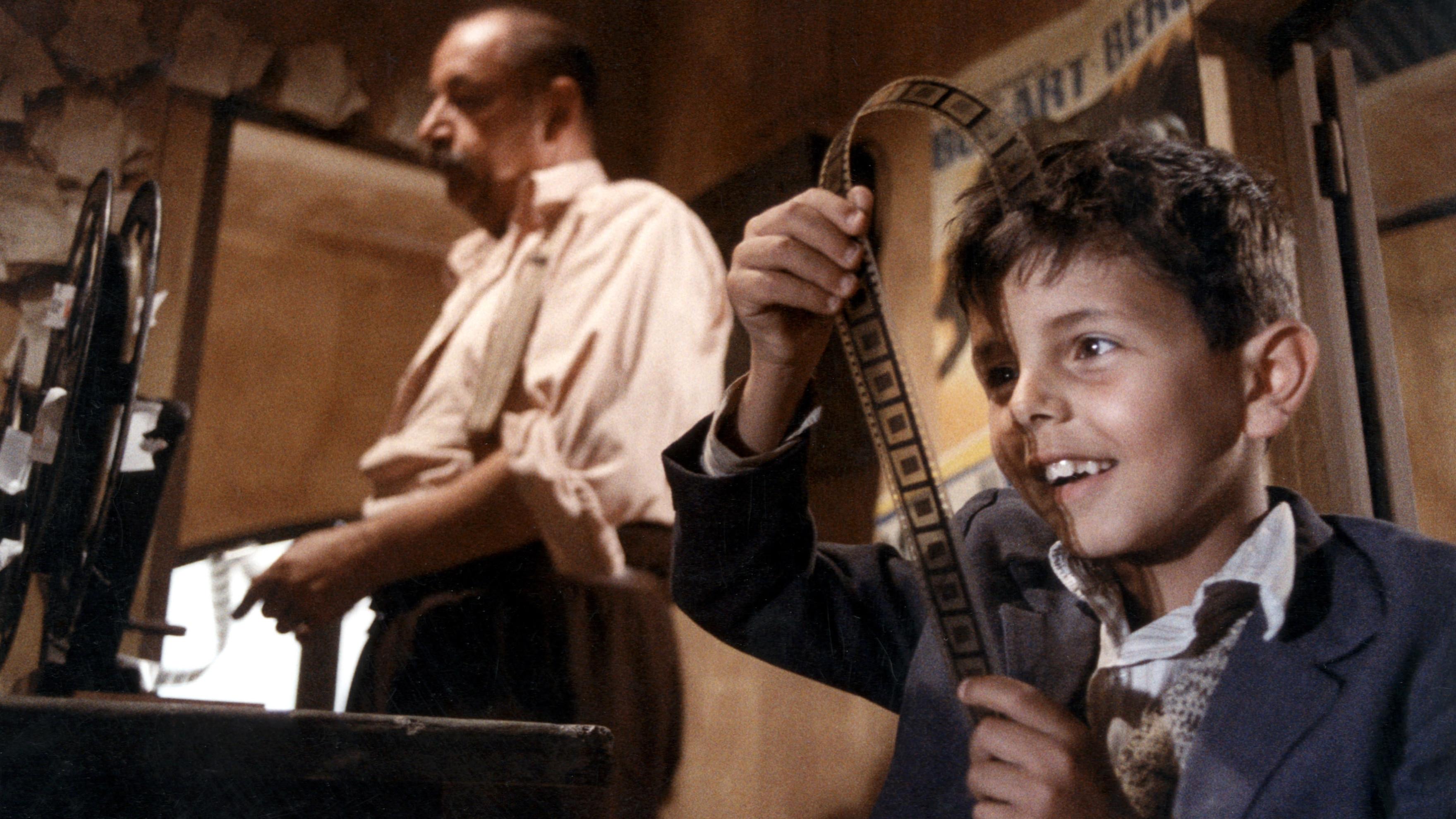
A few years after World War II, eight-year-old Salvatore is the mischievous, intelligent son of a war widow. Nicknamed Totò, he discovers a love for films and spends every free moment at the local movie house, Cinema Paradiso. Although they initially start on tense terms, he develops a friendship with the middle-aged projectionist, Alfredo, who often lets him watch films from the projection booth. During the shows, the audience can be heard booing because there are missing sections, causing the films to suddenly jump, bypassing scenes with romantic kisses or embraces. The local priest, the owner of the cinema, had ordered these sections to be censored, and the deleted scenes are cut from the film reels by Alfredo and piled on the projection room floor, where Alfredo keeps them until he can splice them back in for the film to be sent to the next town.
Alfredo eventually teaches Salvatore how to operate the film projector. One day, Cinema Paradiso catches fire as Alfredo is projecting The Firemen of Viggiù after hours, on the wall of a nearby house. Salvatore saves Alfredo's life, but not before a reel of nitrate film explodes in Alfredo's face, leaving him permanently blind. The movie house is rebuilt by a town citizen, Ciccio Spaccafico, using his winnings from a football lottery. Salvatore, still a child, is hired as the new projectionist, as only he knows how to run the machines.
About a decade later, Salvatore, now in high school, is still operating the projector at the "Nuovo Cinema Paradiso". His relationship with the blind Alfredo has strengthened, and Salvatore often looks to him for help – advice that Alfredo often dispenses by quoting classic films. Salvatore has been experimenting with filming, using a home movie camera; doing this he has met, and captured on film, a girl named Elena Mendola, daughter of a wealthy banker, and has fallen in love with her. Salvatore woos – and wins – Elena's heart, only to lose her due to her father's disapproval.
As Elena and her family move away, Salvatore leaves town for compulsory military service. His attempts to write to Elena are fruitless; his letters are returned as undeliverable. Upon his return from the military, Alfredo urges Salvatore to leave Giancaldo permanently, counseling that the town is too small for Salvatore to ever find his dreams. Moreover, the old man tells him, once Salvatore leaves, he must pursue his destiny wholeheartedly, never looking back and never returning, even to visit; he must never give in to nostalgia or even write or think about them. They tearfully embrace, and Salvatore leaves to pursue his future as a filmmaker.
Back in the present, Salvatore realizes that he is very satisfied with his life from a professional point of view but not from a personal one, so decides to return home to attend Alfredo's funeral. Though the town has changed greatly, he now understands why Alfredo thought it was important that he leave. Alfredo's widow tells him that the old man followed Salvatore's successes with pride and he left him something: an unlabeled film reel and the old stool that Salvatore once stood on to operate the projector. Salvatore learns that Cinema Paradiso is to be demolished to make way for a parking lot. At the funeral, he recognizes the faces of many people who attended the cinema when he was the projectionist.
Salvatore returns to Rome where he watches Alfredo's reel and discovers that it comprises all the romantic scenes that the priest had ordered Alfredo to cut from the films; Alfredo had spliced every kiss together to form a single reel. Totò comes to peace with his past, smiling with tears in his eyes.
Source: Wikipedia (CC BY-SA 3.0)