Summary
Audio uses your browser's built-in voice support.
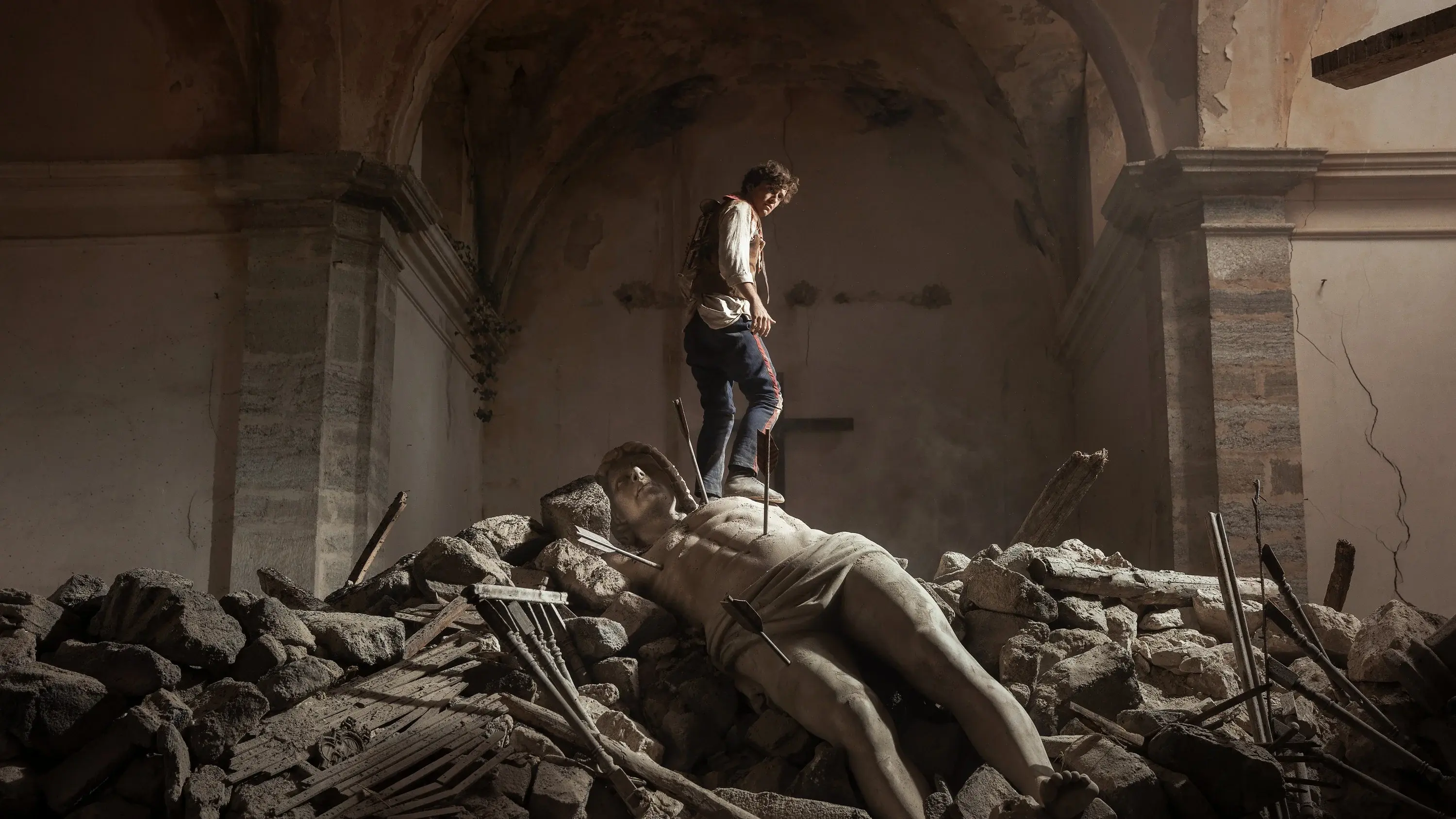
In 1932 Granada, Carlos, a young man from a wealthy family, is refused membership of an exclusive social club after its members vote against him with black balls because of rumours about his homosexuality. His father, Vicente, urges him to deny the rumours and seek admission again. His sister, Valentina, describes the restrictions she faces as a woman, while his mother suggests that he leave for Madrid. During a night out, Carlos dances and encounters an elderly woman mourning her child. He appeals to the club's committee and, when questioned, denies being homosexual. An armed crowd then enters the Casino. When the building is destroyed, Carlos escapes using the painters' scaffolding.
In 1937, during the Spanish Civil War, Sebastián, a young village trumpeter, survives an attack by Italian aircraft on a community preparing to welcome them. His mother is killed. After fleeing the attack, he is forced to join the Nationalist forces to survive. He is assigned to guard Rafael Rodríguez Rapún, a wounded Republican prisoner, and obtain information from him. Rafael had belonged to Federico García Lorca's theatre company, La Barraca, and had been the poet's lover. As Sebastián gets to know him, he falls in love with him and discovers Lorca's poetry. Nené, a singer entertaining the troops, also introduces Sebastián to a world beyond the army.
Rafael asks Sebastián to recover and preserve a manuscript of Lorca's play La bola negra. Sebastián becomes its custodian. Rafael is condemned to death, and Sebastián is placed in the firing squad. After the shooting, Sebastián is shown breaking ranks, approaching Rafael and kissing him. Rafael dies, but Sebastián survives the war and keeps the manuscript.
In 2017, Alberto, a historian with a background in theatre, is researching queer culture while visiting Athens. His estranged maternal grandfather dies and leaves him an inheritance. In Madrid, Alberto lives with Juan Pablo, with whom he has a troubled relationship. Alberto also struggles to communicate with his mother, Teresa, who resents her father's abandonment of her. Among his grandfather's possessions, Alberto discovers what appears to be the complete manuscript of La bola negra, believed to have been left unfinished by Lorca. He investigates its origins and seeks the help of Lorca scholar Isabelle Durand.
Alberto's grandfather is revealed to be Sebastián, who lived with another man while allowing the villagers to believe that they were cousins. Although estranged from his family, Sebastián followed Alberto's theatrical career from a distance, attending a performance and keeping press cuttings. Alberto meets his grandfather's surviving partner, who tells him that Sebastián would have been proud of him. Isabelle confirms the manuscript's authenticity, and Alberto and Teresa begin to reconcile.
Carlos's story forms the film's imagined completion of Lorca's play: in this fictional history, the work was finished and subsequently lost. In its final scenes, Carlos appears in a snowy landscape with skiers and is addressed by the personified Snow, whose voice is that of the elderly woman he met earlier.
Source: Wikipedia (CC BY-SA 3.0)