Summary
Audio uses your browser's built-in voice support.
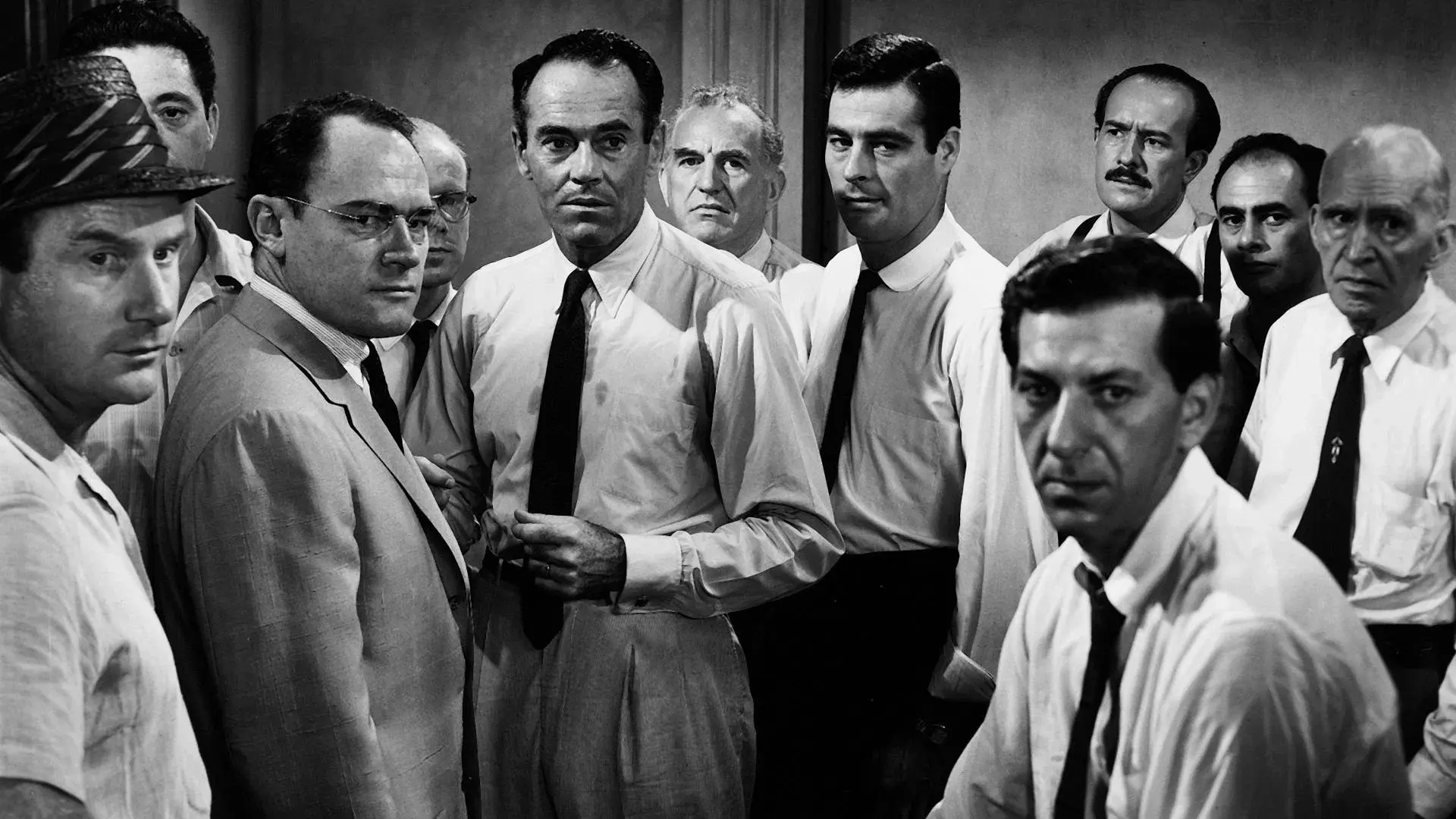
On a hot summer day in the New York County Courthouse, the trial has just concluded of an 18-year-old boy, characterized as a "slum kid", who is accused of killing his abusive father. The judge instructs the jury that if there is reasonable doubt, they must return a verdict of "not guilty". If found guilty by unanimous verdict, the defendant will receive a mandatory death sentence via the electric chair.
At first, the case seems clear. A neighbor who lives opposite testifies to having seen the defendant stab his father, as she lay in bed looking out of her window and through the windows of a passing elevated train into the apartment where the killing took place. A disabled neighbor living below testifies that he heard the defendant threaten to kill his father, then heard the body hitting the floor. He says that on going to his door and opening it, he saw the defendant running down the stairs. The defendant had recently purchased, but claims he had lost, a switchblade of the same type that was found at the murder scene, wiped of fingerprints.
In a preliminary vote, all jurors vote "guilty" except Juror 8, who wants discussion before any verdict. When his first few arguments – including proving that the switchblade, believed to be unique, is in fact not – fail to convince the other jurors, he suggests a secret ballot. This reveals one other "not guilty" vote; Juror 9 reveals that he, too, now agrees there should be more discussion.
Juror 8 argues that the noise of the passing train would have obscured everything the second witness claimed to have overheard. Several jurors question whether the death threat, even if correctly overheard, was simply a figure of speech. Juror 11 doubts that a defendant who was clear headed enough to wipe the blade of fingerprints would risk returning to the crime scene. Jurors 5 and 11 change their votes. After looking at a diagram of the second witness's apartment and conducting an experiment, the jurors determine that it was impossible for the disabled witness to have made it to the door in the time he stated. Infuriated at a comment made by Juror 8, Juror 3 lunges at him and threatens to kill him; all go silent as they realize his words cannot reasonably be taken literally. Jurors 2 and 6 change their votes; the jury is now evenly split.
The victim's stab wound was angled downwards. Juror 5, who has had personal experience with switchblades, points out that such blades are designed to be thrust upwardly, and that a downward thrust from a shorter, experienced assailant is inconceivable, as it would have required the blade to have been repositioned in the killer's hand. Jurors 7, 12 and 1 change their votes, leaving the jurors split 9:3. Juror 10 delivers a prejudiced rant against people from slum backgrounds, and the other jurors distance themselves from him.
Juror 4 states that the evidence from the woman who saw the killing from her bed is incontrovertible, convincing Juror 12 to revert to a guilty vote. After watching Juror 4 remove his glasses and rub the impressions they made on his nose, Juror 9 realizes that the witness was constantly rubbing similar marks on her own nose, showing that she was a regular glasses-wearer despite not wearing them in court. Juror 8 remarks that the witness's evidence must be questionable, as she said she was in bed trying to sleep at the time, when she would not have been wearing her glasses, nor would she have had time to put them on. All jurors apart from Juror 3 now vote not guilty.
Failing to convince the others, Juror 3 explodes in a fit of rage, opens his wallet and rips up a photograph of himself and his son. Seemingly realizing that his strained relationship with his son is the reason for his certainty, he breaks down in tears, and changes his vote. The jurors leave the jury room, now unanimous that the defendant should be acquitted. Juror 8 helps Juror 3 with his jacket. As they leave the courthouse, Jurors 8 and 9 briefly exchange names before parting ways.
Source: Wikipedia (CC BY-SA 3.0)