Summary
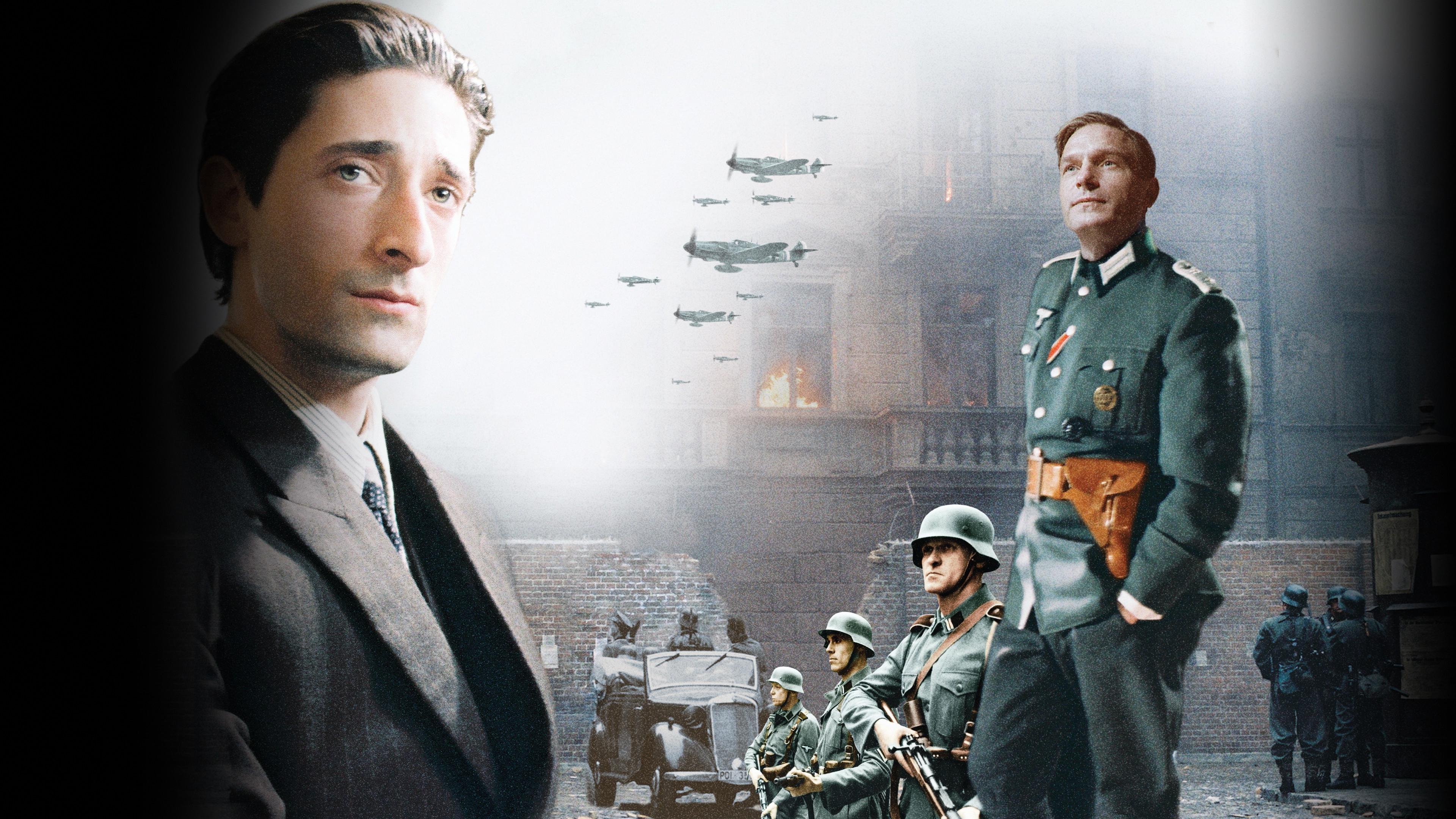
In September 1939, Polish-Jewish pianist Władysław Szpilman plays live on the radio in Warsaw when the station is besieged during Nazi Germany's bombing of Warsaw. Szpilman and his family prepare to leave the city when they learn that Britain and France have declared war on Germany. Relieved at the news, Szpilman stays in Warsaw with his family but with Poland’s invasion, Warsaw falls under Nazi occupation. Jews are persecuted by the new government, stripped of privileges and forced to wear blue Star of David armbands. Szpilman and his family sell their belongings, including his piano, to survive.
The Szpilmans are forced to abandon their home in late 1940 into the overcrowded Warsaw Ghetto where disease and starvation are rampant. Szpilman performs in a café frequented by upper-class Jews, who smuggle in forbidden goods to live comfortably. Szpilman witnesses a young boy savagely beaten by a guard and left for dead while attempting to escape the ghetto. The boy dies despite Szpilman's attempt to save him. Szpilman and his family also witness the SS murder an entire family while raiding a nearby apartment, in which a wheelchair-using man is thrown off the building.
Having failed to obtain legitimate German work certificates, the Szpilmans are ordered to be transported to Treblinka extermination camp in August 1942 as part of Operation Reinhard. Jewish Ghetto Police separates Szpilman from his family at the railhead, allowing him to escape while his family is taken to the death camp. Szpilman becomes a slave labourer and learns of an upcoming Warsaw Ghetto uprising. He smuggles weapons into the ghetto and goes into hiding with help from Andrzej Bogucki and his wife Janina Godlewska.
Szpilman watches the uprising unfold and fail in April 1943. When a female neighbor attempts to report Szpilman, he travels to another hiding place in the German quarter from the husband of his friend Dorota. The new apartment has a piano which Szpilman refuses to play to prevent his identity from being discovered. Szpilman suffers from malnourishment and jaundice, and following a final visit from Dorota and her husband, they obtain a doctor to treat him.
Szpilman recovers by August 1944 when he witnesses the Warsaw Uprising unfold. When Home Army forces attack the Schutzpolizei hospital across the street from Szpilman's apartment building, his home is destroyed by a German tank. Szpilman narrowly escapes and hides in the now abandoned hospital as Warsaw is destroyed in the fighting.
When German troops later attack the hospital with flamethrowers, Szpilman flees through the city's ruins and is discovered by Wehrmacht officer Wilm Hosenfeld, who learns he is a pianist. When Szpilman plays Frédéric Chopin's "Ballade No. 1 in G minor" on the house's grand piano, the officer allows him to continue to hide in the house, providing him food.
When the Germans retreat from the Soviet offensive in January 1945, Hosenfeld promises Szpilman he will listen to him on Polish Radio after the war and leaves him a large supply of food and his greatcoat. After Warsaw is liberated, Szpilman is nearly killed by People's Army troops who mistake him for a German because of his coat.
Hosenfeld is held after the war in a Soviet POW camp. When surviving concentration camp inmates abuse the prisoners, one laments his former career as a violinist. Hosenfeld asks if he knows Szpilman and the violinist promises to bring Szpilman as a character reference but when they return to the site, Hosenfeld and the camp are gone. Szpilman resumes his career, performing Chopin's "Grande polonaise" with an orchestra to a large, prestigious audience.
Source: Wikipedia (CC BY-SA 3.0)